Key points
- Most devices for self-testing (home testing) are modified versions of professional tests, with comparable sensitivity and specificity.
- Self-tests are usually reliable for long-standing infections, but are sometimes unable to detect recent HIV infections acquired in the past few weeks.
- Like any screening test, a reactive (‘positive’) result must be confirmed with one or two follow-up tests.
- Studies show that most people can accurately and reliably use self-testing devices.
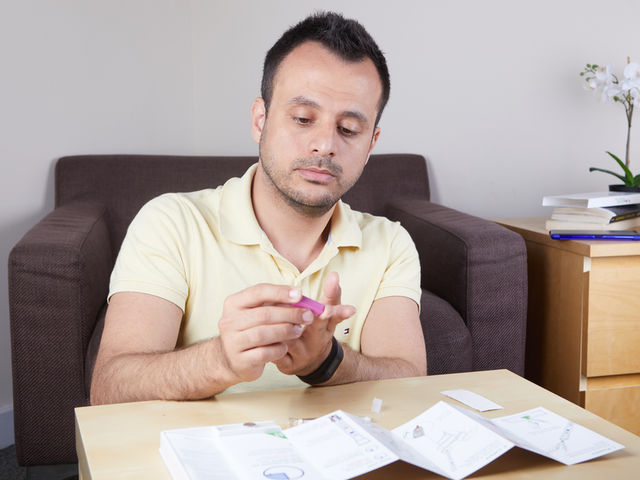
HIV self-testing involves collecting your own specimen (oral fluid or blood) and using a rapid HIV test kit. You perform the whole test yourself, including reading and interpreting the test result.
This is different from HIV self-sampling. With self-sampling, you collect your own sample and send it to a laboratory for analysis. We have another page on the accuracy of self-sampling.
Self-testing is sometimes called ‘home testing’, because people often do it at home. The World Health Organization (WHO) recommends that HIV self-testing should be offered alongside existing HIV testing services.
Different types of tests
Self-tests are usually modified versions of rapid, point-of-care test kits that were originally designed for healthcare professionals. Their processes, packaging and instructions have been simplified so as to guide you through the steps of taking a test.
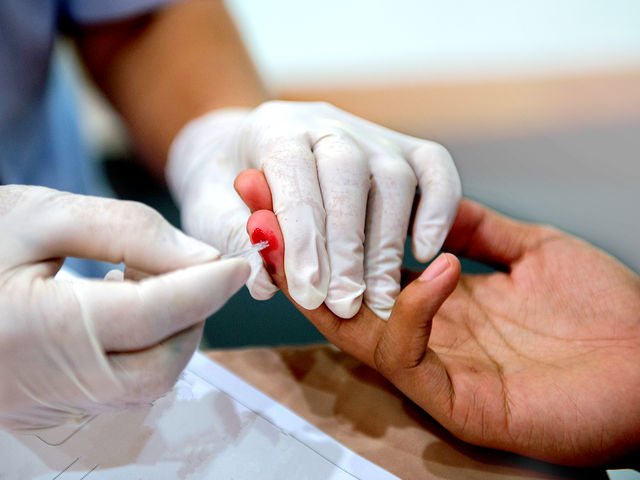
With some tests, you use a lancet to release a small quantity of blood from a fingerprick. Other tests require a sample of oral fluid, obtained by swabbing an absorbent pad around the outer gums, adjacent to the teeth.
Self-tests may be second- or third-generation HIV tests. They are only able to detect HIV antibodies, whereas the fourth-generation HIV tests which are normally used by healthcare professionals are also able to detect p24 antigen (a protein contained in HIV's viral core that can be detected in the first few weeks after infection). Fourth-generation tests are therefore better at picking up recent infections.
Second- and third-generation tests can accurately detect chronic (long standing) HIV infection. But their ability to detect recently acquired HIV is more variable.
Their window periods are a little longer than for other tests. The window period is the time immediately after infection when tests may not detect markers of infection and therefore give a false negative result.
Across the world, the majority of HIV self-tests are based on second-generation testing technology. They can detect immunoglobulin G (IgG) antibodies, but not immunoglobulin M (IgM) antibodies or p24 viral antigen. As these two substances are detectable sooner after HIV infection than IgG antibodies, second-generation tests have longer window periods. The OraQuick In-Home HIV Test, SURE CHECK HIV Self Test and autotest VIH are CE-marked second-generation self-tests.
The SURE CHECK HIV Self Test and autotest VIH are both adapted from a device that is widely used by health professionals. This may be marketed either as the Chembio Sure Check HIV 1/2 Assay or as the Clearview Complete HIV 1/2 Assay. In relation to use by health professionals, American regulators assessed this assay’s sensitivity (proportion of HIV-positive samples accurately described as such) to be 99.7% and its specificity (proportion of HIV-negative samples accurately described as such) to be 99.9%. In relation to the two self-tests, studies to assess the ability of lay users to follow instructions, use the test and correctly interpret its results found that 97-98% achieved a valid result.
Other HIV self-tests are based on third-generation testing technology. They can detect immunoglobulin G (IgG) antibodies and immunoglobulin M (IgM) antibodies, therefore shortening the window period. The INSTI HIV Self Test, Exacto Test HIV and atomo HIV Self Test are CE-marked third-generation tests. In some countries, the atomo device is repackaged and marketed as the Mylan HIV Self Test or as the Newfoundland HIV Test.
The INSTI HIV Self Test is adapted from the INSTI HIV-1/HIV-2 Antibody Test for personal use. This is one of the most accurate third-generation tests available, with a superior sensitivity to recent infection. When used by health professionals, the test’s sensitivity and specificity were both calculated to be 99.8%.
Are people able to understand test instructions and use self-tests reliably?
A review identified 25 studies in which people used self-tests, with their results compared with those of a healthcare worker testing them at the same time. The original studies were done in a mix of North American, African, European and Asian countries. Fifteen studies used oral fluid-based tests, six used blood-based tests and four used both oral and blood specimens. Of note, several studies were evaluating professional assays that had not been adapted for use as self-tests – performance could be better in commercially marketed tests.
The researchers found that most people could reliably and accurately use rapid tests. Using a statistical approach known as Cohen’s kappa in which 1 represents perfect agreement between the results of a self-tester and a trained health worker and less than 1 represents less than perfect agreement, results were highly concordant. The Cohen’s kappa was 0.98 in studies in which users first received a demonstration of how to do the self-test or to interpret its result. In studies in which this was not provided, it was 0.97. This means that in only a small minority of cases the self-tester and the healthcare worker got results that were different from each other.
There were more invalid results in people using blood-based tests (0.4-9.5%) than studies using oral fluid-based tests (0.2-4.5%). Common errors included incorrect or incomplete specimen collection, spilling or incorrect use of the buffer solution, problems transferring blood samples, and difficulties with the interpretation of results.
Although blood-based rapid diagnostic tests might have the potential to deliver more accurate results, more invalid results might occur because the greatest number of user errors was related to standard procedures when capillary tubes and pipettes were used. Simpler test procedures and clearer instructions might mitigate these problems.
Situations in which self-tests may not be accurate
Performance of self-tests is poorer in a number of situations. Results may not be accurate.
What do the test results mean?
There are three possible test results:
1) Negative (may also be described as ‘non-reactive’). The test did not find any evidence of HIV infection. You probably don’t have HIV (so long as you aren’t testing in one of the situations described in the last section).
2) Reactive (often incorrectly described as ‘positive’ by manufacturers). The test assay has reacted to a substance in your blood. This does not necessarily mean that you are HIV positive. It means you need to take more tests to confirm the result. These extra tests are best done at a healthcare facility where they have access to the most accurate HIV testing technologies.
3) ‘Indeterminate’, ‘equivocal’ or ‘invalid’. The test result is unclear. Another test needs to be done.