Skip to content

Most HIV-negative adults have between 500 and 1500 CD4 cells in a cubic millimeter of blood. However, due to natural variation some people may have a CD4 count slightly outside the general range. It can vary by around 100 cells below the lower or above the higher end without any health implications.

CD4 cells are a subset of our immune system that are essential for the teamwork of all other immune cells. They help the other immune cells to launch a well-coordinated attack when there is an intruder such as a virus, bacterium, and the like. CD4s tell the other cells who the intruder is, where to look for it, what tools to use against it, and when to stop.

Our genetic makeup, age and health status have the greatest influence on our CD4 count. However, certain medications and substance use can equally have a measurable effect. What is more, the CD4 count measurement is only a momentary snapshot. Our numbers can vary depending on the time of day (lower in the morning), our nutritional status, and stress levels. Often doctors may order an additional test to check the percentage of CD4 cells which is usually more stable over time.

Zekerie Redzheb

Zekerie Redzheb

Editorial Consultant

Zekerie is a master’s student in virology, a researcher in antiviral treatment and immunotherapy at Sofia University, and tutors general and molecular biology. He has a vested interest in pandemic viruses and pathogen-host interactions. He is particularly interested in HIV cure research, treatment and management as well as environmental and socicultural influences on the wellbeing of people living with HIV. He holds a joint bachelor’s degree in Biological Sciences and English Literature. LinkedIn

Basic information

Better off knowing

Better off knowing

How do I know if I have HIV?

A person wearing a surgical glove holds the hand of somebody else. This person is having their finger pricked with a fine needle. The needle has drawn a small amount of blood which is visible. The image has a pink and purple filter over it.

What are the symptoms of HIV?

Domizia Salusest | www.domiziasalusest.com

What is the difference between HIV and AIDS?

Illustration of HIV virus.

Very recent infection

Very recent infection

Myths and facts

Myths and facts

What is p24 antigen?

A close-up of somebody's hand in a blue surgical glove holding a vial of blood hand.

CD4 and viral load

CD4 and viral load

Undetectable viral load

Undetectable viral load

What is the normal CD4 count for someone taking HIV treatment?

Health checks for people with HIV

Health checks for people with HIV

What does undetectable mean?

Will I test negative if my viral load is undetectable?

What is a viral load blip, and does it matter?

HIV testing

A close-up of a glass receptacle which contains a testing vial. This vial is labelled as being ready to receive blood for an HIV test. The image has a pink and purple filter over it. The image has a pink and purple filter over it.

Home HIV testing (self-testing and self-sampling)

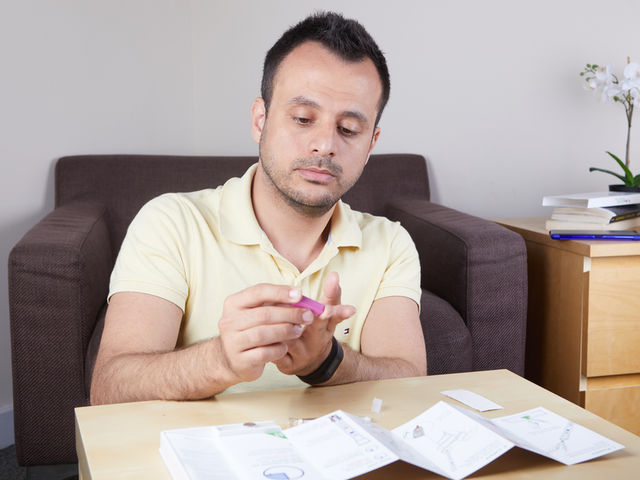
A man pricks his finger so that he can test himself for HIV. In front of him are the instructions for the test. He is concentrating on pricking his finger. The image has a pink and purple filter over it.

HIV testing for trans and non-binary people

Mareike Günsche | www.aspect-us.com

Early HIV infection

A woman site on the sofa with a blanket over her and around her shoulders.

CD4 cell counts

A vial of blood is resting on a form that indicates it will be tested for CD4 cells. The image has a pink and purple filter over it.

CD4/CD8 ratio

A person wearing a blue surgical glove holds a vial of blood in front of a bloodwork form. The option "CD4 CD8" is checked. The image has a pink and purple filter over it.

Viral load

A close up of a person's arm while they are having their blood taken. The person taking the blood is wearing surgical gloves. We can see some of the blood is already in the tube.

What are logs in viral load results?

Vial of blood ready for viral load testing